El consejero de Seguridad Nacional, Tom Donilon, asegura que la muerte de Osama Bin Laden es un paso importante, pero la lucha contra el terrorismo continúa.
El consejero de Seguridad Nacional de la Casa Blanca, Tom Donilon, señaló hoy que la muerte de Osama bin Laden es "un paso fundamental" en la lucha contra el terrorismo pero, aún no se puede "declarar a Al Qaeda como estratégicamente derrotada".
"Continúan siendo una amenaza para EU. Pero en este momento hemos dado un paso fundamental en términos de desmontar esta organización", explicó Donilon en una entrevista en NBC.
El consejero de Seguridad reiteró que la operación militar en la que murió el jefe de Al Qaeda en Paquistán hace una semana fue "apropiada", ya que fue atacado "su cuartel general".
"El mensaje es que Estados Unidos hace lo que dice que va a hacer", enfatizó Donilon.
También se refirió a la colaboración de Paquistán y las dudas que ha generado el hecho de que EU no informara al Gobierno paquistaní del ataque hasta que las tropas estadounidenses habían salido del país.
"No fue una cuestión de confianza, fue cuestión de proteger la seguridad de la operación", dijo posteriormente en el canal ABC.
Donilon reiteró una vez más que Paquistán es un "importante socio" de EU y que "hasta la fecha no hay evidencia política o militar de que conociera que Bin Laden estaba en su territorio".
No obstante, dijo que hay que reconocer el hecho de que "Osama Bin Laden estaba escondido a apenas 50 millas de la capital paquistaní en una localidad que se considera eminentemente militar".
Por lo que indicó que es necesaria una "investigación a fondo" por parte de las autoridades paquistaníes.
Donilon informó que Washington había solicitado acceso a las tres mujeres de Osama Bin Laden detenidas por las autoridades de Paquistán, pero que hasta el momento no se les había permitido interrogarlas.
EU espera "tener acceso a las cosas que necesitamos y seguiremos presionando para conseguirlo", agregó Donilon.
Por último, apuntó que los servicios de inteligencia siguen revisando el material incautado durante la redada de la pasada semana, del cual ayer EU hizo públicos cinco videos caseros en los que se ve al líder de Al Qaeda ensayar discursos propagandísticos y revisarlos en televisión.
"Es la mayor cantidad de inteligencia conseguida sobre cualquier terrorista hasta el momento. Según la CIA (la agencia de inteligencia estadounidense), es del tamaño de una pequeña biblioteca universitaria", añadió el consejero de Seguridad Nacional de la Casa Blanca.
El Universal
Sunday, May 8, 2011


Saturday, May 7, 2011
Busca el Gobierno reclutar a alumnos en el país para Policía Estatal Acreditable

Pretenden enrolar a unos 60 mil jóvenes de todo el país en tareas de seguridad. "Tu tierra, tu gente, nuestra seguridad", es el título de la convocatoria que difunden escuela por escuela.
El Gobierno federal lanzó ayer la convocatoria. Se buscan jóvenes que quieran proteger a su gente mediante la cual pretende reclutar a estudiantes de nivel medio superior al nuevo modelo de Policía Estatal Acreditable.
Con la propuesta, el Gobierno intenta fortalecer los cuerpos policiales locales para enfrentar a la delincuencia y al mismo tiempo ofrecer proyectos de vida a jóvenes que cursan ese nivel educativo en escuelas como el Conalep los CTISyCBTIS.
Ante los Secretarios de Gobernación Francisco Blake y de Educación, Alonso Lujambio Lardizábal, así
como de la Procuradora Marisela Morales y decenas de estudiantes el secretario ejecutivo del Sistema Nacional de Seguridad Pública Juan Miguel Alcántara Soria, aseguró que en un primera etapa
buscan enrolar a más de 60 mil jóvenes de ambos sexos en todo el País, excepto Yucatán, entidad que no se adhirió al convenio.
"Vamos por un promedio de dos mil jóvenes de ambos sexos en cada entidad federativa para conformar este primer módulo de Policía. Estos jóvenes como los que hoy nos acompañan y que buscamos deben someterse a la exigencia legal de evaluaciones periódicas establecidas por el Centro de Control de Confianza, para comprobar el cumplimiento de los perfiles de personalidad éticos socioeconómicos y médicos en los procedimientos de ingreso, promoción y permanencia".
Detalló que la estrategia es realizar el reclutamiento yendo plantel por plantel y aula por aula a más de mil 200 planteles. Sin embargo, el jueves pasado, durante su participación en el Tercer Foro sobre Seguridad y Justicia, Alcántara Soria reconoció que la convocatoria difundida meses antes en diferentes estados resultó un rotundo fracaso.
En entidades fronterizas donde se vive una ola de violencia generada por el crimen organizado como en Nuevo León, Tamaulipas, Chihuahua y Sinaloa se inscribieron un promedio de entre 30 y 50 jóvenes, por ello se decidió relanzar la propuesta de manera fortalecida.
Ayer, Lujambio pidió a los estudiantes contribuir con su esfuerzo a fortalecer el estado mexicano. "Creemos que con su talento, con su integridad ética, ustedes jóvenes que así lo deseen, pueden contribuir a este esfuerzo tan importante del Estado mexicano desde la sociedad mexicana. Queremos construir un México seguro que todos queremos y todos merecemos, y ciertamente estas labores específicas de análisis, de datos de análisis táctico de inteligencia policial, ustedes podrían desarrollarla y sería de especial utilidad para México", destacó.
La alumna Fernanda Deyanira González, representante de los Conalep, ofreció un discurso en el que enfátizó sobre la crisis de valores la cual empujan a jóvenes a las filas de la delincuencia.
"Cuando nuestro ejemplo arrastre, entonces sí podremos hablar en positivo de lo que es la seguridad pública y dejando para la historia el concepto en negativo de la inseguridad. De mí parte y a nombre de mis compañeros, dejo constancia de nuestro compromiso por exigir y sobre todo por exigirnos a nosotros mismos pregonar con el ejemplo y buscar que cada uno de nuestros actos, aún el más sencillo, sea un ejemplo entre nosotros y para nuestros compañeros más pequeños", destacó.
REFORMA
Friday, May 6, 2011
Heads Up, Mexico: You May be Next

Taken from freedominourtime.blogspot.com
The time has come, insists Representative Michael McCaul (R-Texas), "for the U.S. to show serious commitment to war in our own backyard."
It's shamefully narrow-minded of Washington to confer the blessings of humanitarian mass murder on distant Bedouins while ignoring our Mestizo neighbors to the South. McCaul, a former federal prosecutor who now chairs the Homeland Security Subcommittee on Oversight, is eager to help rectify that inequity by designating six Mexican drug syndicates -- including Los Zetas, which is led by U.S.-trained military personnel -- as "foreign terrorist organizations."
This would permit deportation or prosecution of anyone providing "support" to the narcotics syndicates. Of course, this wouldn't apply to the public officials in the United States responsible for the huge narcotics price support program called the "War on Drugs."
Over the past five years, an estimated 37,000 people have been killed as a result of the U.S.-funded war between the administration of Mexican President Felipe Calderon and various narcotics syndicates. Several months ago, Texas Governor Rick Perry suggested that Washington should invade Mexico for the supposed purpose of ending the violence. The only trivial impediment to that plan, Perry observed, is that Mexico's government would have to "approve" of the invasion.
As if to answer the question, "What kind of Latin American political figure would `approve' of a U.S. invasion and occupation of his country?" Colombian-born Washington Post columnist Edward Schumacher-Matos offered a very public endorsement of the proposal.
It's worth pointing out that between positions with the New York Times and the Wall Street Journal and his present gig at the Post, Schumacher-Matos taught a course at Harvard's David Rockefeller Center for Latin American studies, which is one of several academic nurseries in which the Establishment cultivates tomorrow's Quislings.
Schumacher-Matos piously chastises Mexico's political class for being "too proud to do what they immediately should: Call in the Marines." Only if Mexican somehow emerge from "their nationalistic stupor" will they see the light of reason and welcome the presence of their new overlords -- "American military specialists stationed within [their] borders to help the country build powerful electronic intelligence systems and train modern military and police forces to replace its suffocatingly hierarchical, outdated ones."
Although Mexico "is our neighbor and supposed longtime ally, the Mexican army has never -- never -- participated in a joint military exercise with the U.S. military," Schumacher-Matos points out, inviting us to sorrowful contemplation of the shame of it all. To substantiate the point, he cites a recent study by Roderic Ai Camp of the Woodrow Wilson Center, oblivious to the irony of mentioning Wilson's name in connection with proposed U.S. military intervention in Mexico.
"What is getting in the way of deeper cooperation with the U.S. military is that the Mexican military, political and intellectual leaders, abetted by U.S. intellectuals, still have their heads in the Mexican and American wars for the 19th century and the Cold War of the 20th," Schumacher-Matos scolds. "They talk of imperialism and hegemony -- which are irrelevant today."
This isn't "imperialism" that we're discussing, insists this Rockefeller-suckled sock puppet: It's applied humanitarianism of the kind that has turned places like Iraq, Afghanistan, Pakistan, Somalia, Kosovo, and Libya into havens of peace and prosperity.
Elements of Schumacher-Matos's prescription are a bit outdated. The "electronic intelligence systems" he describes are already operating in Mexico; huge amounts of money are being poured into training and equipping Mexican military and police; and U.S.-trained paramilitaries are actively involved in the Drug War -- on both sides of the conflict.
"The U.S. agents generally provide intelligence and training, while Mexicans do the hands-on work," explains a recent AP dispatch from Mexico City. Brad Barker, president of a "private" mercenary firm called HALO Corporation, told the AP: "Yes, we're tracking vehicles, yes, we're tracking people.... There's been a huge spike in agents down here."
For the nonce, however, the huge and growing population of U.S. military and intelligence "advisers" infesting Mexico have to "play down" their role, in order "to avoid rubbing nationalist raw spots."
The division of labor used to maintain the fiction of Mexican independence was displayed in joint operations staged to murder Arturo Beltran-Leyva, the admittedly vicious head of a narcotics operation (an offshoot of the Sinaloa Cartel) he co-founded with his four brothers. On December 11, 2009, a team of U.S.-trained Mexican Special Forces operators, acting on intelligence gathered by their American "advisers," attacked a Christmas party, slaughtering several guests, wounding numerous others, and terrorizing scores more while Beltran-Leyva fled.
Several days later, U.S. agents tracked the fugitive to an apartment in Cuernavaca. This time 200 special forces troops laid siege to the building, surrounding it with tanks and helicopter gunships.
The outcome was predictable, and proudly memorialized in trophy photos of Beltran-Leyva's dead, mutilated body that were given wide circulation by the Mexican government.
This assassination was hailed as a significant "victory" in Washington's drug war in Mexico. Indeed, from the perspective of the people who manage that war, it was an ideal victory -- the kind that helps perpetuate the conflict, rather than bringing it to an end. As the AP points out, in the year following the killing of Beltran-Leyva, arrests of drug cartel leaders were up, cocaine seizures expanded, and extraditions of drug suspects to the U.S. increased -- "and yet, killings jumped to a record high ... and more heroin and marijuana are being produced in Mexico and smuggled into the U.S."
As with all other "successful" government programs, Washington's narco-war in Mexico is a breeder reactor for larger and even more profitable problems. The escalating violence by Washington and its puppet government in Mexico City is provoking retaliatory violence against American assets.
Washington's proxy war in Mexico has killed tens of thousands of Mexicans, as well as a small but growing number of U.S. citizens. What really prompted the ire of Rep. McCaul, however, was the murder last February of Immigration and Customs Enforcement Agent Jaime Zapata by a hit team employed by Los Zetas. This episode, in which a Federal Agent was assassinated by a cartel led by U.S.-trained Mexican paramilitaries that led McCaul to demand that Mexican drug syndicates be classified as "foreign terrorist organizations."
While Mexican President Calderon has “boldly declared war against the cartels," McCaul declares, "the Mexicans are losing the war – and so are we.”
Of course, the most effective way to destroy the criminal syndicates -- as a growing number of war-weary Mexicans understand -- would be to de-criminalize narcotics, which would mean an immediate end to the grotesquely inflated profits that sustain the cartels.
McCaul and his ilk, however, prefer to take the contrary approach -- continued escalation of the conflict with no imaginable end. "We can't afford a failed state in Mexico, and we must secure our borders," intones McCaul.
Let's briefly examine this familiar piece of thought-stopping boilerplate.
Since the housing bubble burst four years ago, immigration from Mexico is down dramatically. The chief threat to "border security" at present is the violence being churned up in Mexico through Washington's drug war. If the threat of "spillover" narcotics violence is the main problem, ending the drug war is the obvious solution -- yet ideologues like McCaul have a way of resisting the obvious.
For those who understand that the state is always and everywhere the chief enemy of liberty, prosperity, and peace, the term "failed state" is a pleonasm. When employed by spokesmen for the Imperial power elite, however, the term is invoked as a prelude to military intervention in order to impose a government-exercised monopoly on force -- which in practice has meant becoming local franchises of a U.S.-dominated global political system.
Interventions of this kind are justified as a form of preventive counter-terrorism. Accordingly, whenever U.S. politicians and policy-makers suggest that Mexico is in danger of becoming a "failed state," they are tuning the atmosphere for even more forceful intervention in that country's domestic affairs.
It shouldn't surprise us to learn that a growing number of Mexicans are weary of being on the receiving end of Washington's armed benevolence.
"We are fed up with this war that nobody asked for," exclaimed Ciudad Juarez resident Leticia Ruiz, one of thousands of Mexicans who attended protests on April 6 demanding an end to Washington's drug war in Mexico.
"We're sick of you politicians," declared Javier Sicilia, a noted Mexican author whose 24-year-old son was murdered by cartel hit-men. "In this badly planned, badly executed and badly led war, you have put the country into a state of emergency."
The horrors being visited on Mexicans in this unnecessary war are of little concern to the ruling elite on either side of the border. As Hillary Clinton admitted in a moment of stunning candor, de-criminalization of narcotics and de-escalation in the drug war simply aren't possible, because there is "too much money" to be made through prohibition. One illustration of this can be seen in the fact that when the global finance system went into cardiac arrest in 2008, laundered narcotics proceeds were the only liquid capital available for inter-bank loans.
Many law enforcement agencies in the United States have become addicted to drug war subsidies, both in the form of funds stolen and redistributed through taxation and in the form of direct highway robbery by way of "asset forfeiture." The Texas legislature has sought to expand that symbiosis between the criminal underworld and the even more disreputable political "overworld" by expanding the use of highway checkpoints -- for seatbelt enforcement, license and insurance inspections, and drug and weapons searches -- in order to harvest revenue to make up for shortfalls in tax revenue.
Significantly, Rep. McCaul points out that his proposal to designate drug cartels as "terrorist" organizations would "intensify southbound inspections to seize weapons and cash." In practice this would mean an escalation in Washington's unremitting war against privacy and private property.
Rep. McCaul himself illustrates another reason why there is no official interest in ending the drug war. As the Houston Chronicle points out, McCaul "unveiled [his] legislation as he raises his profile in Washington for a possible bid for statewide office" -- specifically, the Senate seat being vacated next year by Kay Bailey Hutchison. Being a dutiful drug war drone is a prescription for job security -- and in many cases, the key to a lucrative political career. Despite growing public disenchantment with this murderous charade, there is no political profit in working to bring it to an end.
No hyperbole is involved in describing Mexico as another front in the Regime's war with -- well, practically everybody. This is illustrated by the fact that several months ago, beginning with a September 2010 installment of Oliver North's "War Stories" agitprop series, the Fox News Channel has been referring to the proxy conflict in Mexico as America's "Third War" (which would mean, of course, that the ongoing campaign in Libya would be the Regime's fourth war).
Like other spokesmen for the War Party, Rep. McCaul has promoted a unified field theory of global conflict in which Mexico is emerging as a haven for Islamic terrorists bent on destroying the U.S. Although there's no evidence of an Islamist/Narco-terrorist alliance, undisguised U.S. military intervention in Mexico could conceivably provoke a nationalist backlash that would serve the War Party's propaganda needs nearly as well.
For decades, some elements of the Right (occasionally abetted by people who should have known better) have peddled the notion that Mexico has created a vast and well-organized "fifth column" within the United States dedicated to La Reconquista -- the re-conquest of territories seized by the U.S. during the Mexican-American War.
In this scenario, non-assimilated Mexicans by the millions join in a campaign of violence orchestrated by the Mexican government with the help of foundation-funded anti-American groups on this side of the border.
Whatever revanchist sentiments may exist in Mexico are the residue of Washington's seizure of roughly half the country through a war of aggression. Washington's proxy narco-war has done nothing to palliate those feelings. About the only thing that could vindicate the alarmist fantasy of a nationalistic uprising on the part of Mexicans living on the U.S. side of the border would be direct U.S. military intervention in Mexico. I'm just cynical enough to believe that this would be considered a selling point to the people who profit on the misery inflicted by Washington's drug wars, both here and abroad.
El 'Chapo' ocupa ahora el lugar de Osama como el hombre más buscado

México, D. F., mayo 6 (EL UNIVERSAL).- Después de la muerte de Osama Bin Laden, líder de Al Qaeda, el puesto número uno en las listas de los hombres más buscados por las agencias internacionales de seguridad quedó vacante.
“The Guardian”, uno de los diarios más importantes del Reino Unido y Europa, estimó que el narcotraficante mexicano Joaquín "El Chapo" Guzmán es el indicado para encabezar la lista de más buscados del mundo, por encima de personajes como Semion Mogilevich, jefe de la mafia rusa; Felicien Kabuga, uno de los responsables del genocidio en Ruanda; e incluso de Matteo Messina Denaro, cabeza de la Cosa Nostra italiana.
Para el diario inglés, si bien no hay un consenso entre las agencias como el FBI, DEA o Interpol sobre cuáles criminales deberían enlistarse, Guzmán Loera podría ocupar el lugar de Bin Laden, quien murió en un operativo de las fuerzas especiales de Estados Unidos en Paquistán.
En un artículo, el periodista John Henley enlistó a los 10 fugitivos más buscados por las agencias internacionales. El ranking titulado "Los nuevos 10 más buscados", que se elaboró a partir de una lista realizada por la revista Forbes, colocó en primer lugar a Guzmán Loera, a quien calificó como un hombre "implacable y determinado".
La publicación refirió que el líder del cártel de Sinaloa ha tenido éxito al transformar a Ciudad Juárez "de un punto estratégico de contrabando, a una de las capitales mundiales del crimen". Recordó además que la organización criminal de Guzmán Loera mantiene un combate directo contra el cártel del Golfo y La Línea, lo que ha desatado la violencia en la región.
"El cártel de Sinaloa trafica toneladas de cocaína desde Colombia a través de México a los Estados Unidos, además de estar involucrado en el mercado de las metanfetaminas, la mariguana y la heroína en el país", aseguró “The Guardian”.
El periodista acotó que las agencias de seguridad internacionales no coinciden al señalar a los criminales más buscados y no priorizan entre uno u otro por lo que no les otorgan un lugar especial en sus listados.
Todo pareciera indicar que "El Chapo" se está ganando un nuevo pseudónimo: "El hombre de las listas". Y es que el narcotraficante sinaloense ha aparecido en tres ocasiones en la lista de los hombres más ricos del mundo según Forbes, y de igual forma ocupa un lugar predilecto en el ranking de los más buscados de la Agencia antidrogas de Estados Unidos (DEA, por sus siglas en inglés), posición que se ganó en enero de 2001, junto con una recompensa de cinco millones de dólares por información que lleve a su captura.
Por si fuera poco, en 2009 la revista estadounidense “Time” lo incluyó en su lista anual de las cien personas más influyentes del mundo, por el poder y la fortuna que atesora a través de sus actividades ilícitas.
Según Forbes, Joaquín Guzmán tiene 56 años y posee una fortuna de por lo menos mil millones de dólares, lo que lo ubica en la posición 1140 entre los más acaudalados del planeta. Además lo ubica como el responsable del 25% del tráfico de drogas de México a Estados Unidos.
yahoo.com.mx
Sunday, May 1, 2011
Wikileaks: Al-Qaeda plotted chemical and nuclear attack on the West

Another 'false flag' attack in the making?
Extracted from The Telegraph
Guantanamo interrogators have uncovered a determined attempt by al-Qaeda to attack Western countries using chemical or nuclear weapons, according to the top-secret files.
One of the terrorist group’s most senior figures warned that al-Qaeda had obtained and hidden a nuclear bomb in Europe that would be detonated if Osama bin Laden was killed or captured.
Khalid Sheikh Mohammed, the al-Qaeda mastermind currently facing trial in America over the 9/11 atrocities, was involved in a range of plans including attacks on US nuclear plants and a “nuclear hellstorm” plot in America.
A number of the conspiracies admitted by detainees during interrogation in Cuba seem improbable, but other plans were detailed and thoroughly analysed.
Some detainees displayed an apparently comprehensive knowledge of Western countries’ defences against nuclear attack.
According to the US WikiLeaks files, a Libyan detainee, Abu Al-Libi, “has knowledge of al-Qaeda possibly possessing a nuclear bomb”. Al-Libi, the operational chief of al-Qaeda and a close associate of Osama bin Laden before his detention, allegedly knew the location of a nuclear bomb in Europe that would be detonated if bin Laden were killed or captured.
Sharif al-Masri, an Egyptian captured in 2004, allegedly claimed that Al-Libi had said the nuclear bomb’s operatives “would be Europeans of Arab or Asian descent”. The notes show that US interrogators spent large amounts of time trying to establish whether al-Qaeda had access to nuclear material.
Salman Yehah Kasa Hassan, a Yemeni operative, allegedly said that “an associate of his brother was apprehended attempting to sell uranium for $500,000”. However, after the Yemeni authorities confiscated the uranium, “it was rumoured to have disappeared in a transaction with [Osama bin Laden]”.
Mohommad Zahir, a “weapons dealer” from Afghanistan, was arrested in 2003 allegedly carrying a memo referring to “two or three cans of uranium”, “intended for the production of an 'atom bomb’”.
Another detainee “discussed the issue of buried uranium in Kandahar”.
Other detainees talked about “a ship purchased by al-Qaeda” which was intended to be used “to transport weapons, explosives, and possibly uranium purchased from countries along the Red Sea and Mediterranean Sea”.
Of particular concern to the US was a network of nuclear scientists and military officers called “Ummah Tameer Nau”, which was set up “to assist in spreading the modern achievements of science and technology among Muslims”.
Al-Qaeda apparently also regularly explored the use of chemicals in attacks, believing that getting these into the US would be easier than nuclear material. The use of biological agents, including anthrax, was also considered. One detainee allegedly claimed that Ammar al-Baluchi, the nephew of Khalid Sheikh Mohammed, discussed “how to smuggle explosives and chemicals into England”.
According to the US documents, another key al-Qaeda operative discussed a “dirty bomb” with other plotters, which “would combine a regular explosive with uranium or other radiological material”.
The nuclear material “would be disbursed throughout a limited region due to the blast, exposing all within the area to the radiated material”. The terrorists’ aim was to cause “latent illness for most, as well as widespread panic far exceeding the affected area”.

Reporta la casa blanca la muerte de Bin Laden


Justo cuando las estadisticas de aprobacion de la presidencia de Barack Obama, alias Barry Soetoro andan por los suelos, mas bajas que las de George Bush 2, la Casa Blanca reporta la supuesta muerte de Osama Bin Laden.
Los rumores acerca de la muerte de Bin Laden han sido abundantes, a partir de el 2005 cuando la CIA presento supuestos videos de Bin Laden con una persona diferente haciendo el papel. Tambien cabe mencionar que la ex primer ministro pakistani Benazir Bhutto menciono su muerte poco antes de ser asesinada ella misma.
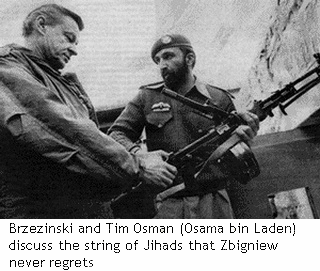
Osama Bin Laden fue lider de la resistencia afgana cuando la entonces URSS invadio el pais, y su grupo, los 'Mujahideen' fue financiado y entrenado por la CIA, a traves del estratega globalista y actual asesor de Obama, Zbigniew Brzezinski.
La noticia en estos momentos se desarrolla, estamos a la espera del comunicado del titere Obama.
Subscribe to:
Posts (Atom)